
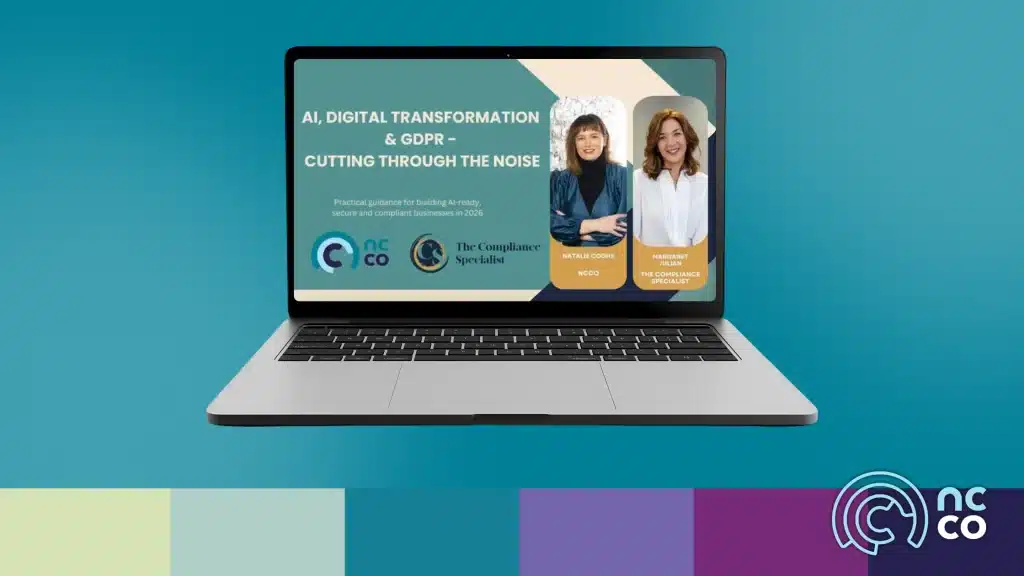
AI is everywhere right now, and it comes with a lot of noise: big promises, quick-fix messaging and pressure to move fast. Businesses shoulnd’t be asking whether AI matters (we know it does!), they should be asking whether the right foundations are in place before they start relying on it.
That was the focus of a recent info session between Margaret Julian, GDPR and Compliance Specialist, and Natalie Garland-Cooke, CRM and Digital Transformation Specialist at ncco. Together, they chatted about the often-overlooked middle ground between business strategy and digital transformation: the practical foundations that need to be in place before AI can deliver real value.
The message was clear. Like any business strategy, AI should not be a leap of faith- it should be a calculated step.
The four foundations of AI readiness
1. Data: the fuel
AI is only as good as the data behind it. If your data is incomplete, duplicated, outdated, or spread across disconnected systems, the outputs will be unreliable. In simple terms: rubbish in, rubbish out.
This is why clean, connected data is so very important. Businesses need a single source of truth so that information is accurate, accessible, and consistent across the organisation. Without that, AI tools can produce poor recommendations, weak insights, or content that simply misses the mark.
At ncco, this is a core part of digital transformation work: helping businesses remove silos, improve data quality, and make sure systems are feeding from the same reliable information.
2. Systems: the engine
You cannot automate chaos. If your workflows are unclear, inconsistent, or undocumented, AI has no reliable process to follow.
Strong systems are what turn technology into something useful. That means having clear workflows, defined responsibilities, and proper audit trails in place. It also means understanding how your tools connect with one another, where information is flowing, and where it is getting stuck.
Before introducing AI, businesses should ask: do our current systems support the way we actually work? If not, AI will only magnify the gaps.
3. Security: the shield
Security is not just an IT issue. It’s a business issue, a trust issue, and a brand issue.
As businesses adopt more digital tools and AI-powered solutions, the need to protect data becomes even more important. Customers, clients, and stakeholders need confidence that their information is being handled responsibly. If that trust is broken, the reputational damage can be far greater than the cost of any software.
Strong security practices help protect both the business and the people it serves. They are not optional extras. They are part of building a sustainable digital strategy.
4. Compliance: the compass
Compliance is often seen as something that slows innovation down when, in reality, it ‘ what allows businesses to move forward with confidence.
Governance, evidence, and accountability matter. As Margaret Julian highlighted during the session, compliance should not be treated as a handbrake. Rather, it is the compass that helps businesses adopt new technologies responsibly and in line with regulatory requirements.
When AI is introduced without proper governance, businesses expose themselves to unnecessary risk. When it is introduced with the right compliance framework, it becomes far easier to scale with confidence.
Why this is important for digital transformation
Digital transformation is not about layering new tools on top of old problems. It is about creating the right conditions for technology to support the business properly. (You might like to read that sentence again.)
That means looking at your data, your systems, your security, and your compliance together, not as separate conversations. AI may be the accelerator, but if the underlying structure is weak, it’s not going to take you where you need to go.
For many businesses, the smartest next step is not to rush into another tool. It is to pause, assess what is already in place, and strengthen the foundations first.
A practical, independent approach
At ncco, Natalie Garland-Cooke provides independent, tech-agnostic advice to help businesses build those foundations from the inside out. The goal is not to push a particular platform, but to make sure your systems, processes, and data are aligned so that any future investment in AI or digital transformation is grounded in reality.
And where GDPR and compliance support is needed, Margaret Julian brings the specialist expertise to help businesses move forward in a way that is both practical and responsible.
AI is a powerful accelerator. But before you press start, make sure you are pointing in the right direction!